
I became so interested in all things Basque and the background that resulted in such a unique and intriguing region, so couldn’t resist doing a bit of research..…..
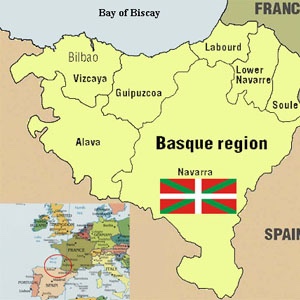
GEOGRAPHY: The Basque Country is an autonomous community in the western Pyrenees Mountains that straddles the border between northwest Spain and southwest France – although called a country, it’s not an independent territory. It has survived invasions throughout time and wasn’t until the 16th Century that the Basques on the Spanish side of the Pyrenees finally agreed to be part of Spain, as long as they could partially govern themselves. By 1876, all of the Basque Country was under the control of either France or Spain. Today, the Basque country comprises four regions on the Spanish side of the Pyrenees (Vizcaya, Guipúzcoa, Navarra and Alava) and three on the French side (Labourd, Basse-Navarre and Soule). Collectively these territories are called Euskal-Herria (Land of the Basques) or Euskadi.
PEOPLE: The inhabitants are an entirely different ethnic group, thought to be the oldest ethnic group in Europe. In fact, historians believe they have inhabited the south-western corner of Europe since before Indo-European peoples came to the area some 5,000 years ago. The people have survived numerous invasions yet still retain a deep-seated sense of autonomy. According to a study, Welsh and Irishmen are genetic blood-brothers of the Basque people.
LANGUAGE: Being one of the oldest ethnic groups in Europe, the language of Euskera is one of the oldest languages still spoken today. It is not related to any other Latin language, such as Spanish or French, and is completely unique – in fact, it is called a ‘language Isolate’. The language was spoken in most rural Basque areas until the end of the 19th century even though they were part of Spain, but during Franco’s regime it was banned, however it is now making a revival. Basque is only strange and exotic because it is not an Indo-European language. … In fact, it is the SOV (subject-object-verb) word order of 45% of the languages of the world whereas SVO is the word order of only 42%. (I did warn you I’d done some research – the more I looked, the more fascinating this linguistic history became!). Japanese and Turkish are two other well-known languages which have the SOV word order. Some examples of their strange phonetics: bird and butterflies txoriak eta tximeletak, tree zuhaitz, sunny eguzkitsu, beach hondartza…….it looks so weird and different!
FESTIVALS: A notorious annual “running of the bulls” takes place in the Basque town of Pamplona. Every day for a week, six bulls are let loose in the streets to run to the bullfighting stadium while crowds of white-clad young men dare fate by running ahead of the bulls and use rolled-up newspapers for defence. Must be a sight to behold!
FOOD: Food plays a huge part in Basque culture which is probably why it is so well known for its food today and also explains why it’s home to so many Michelin-starred restaurants. Eating for Basques is not just for sustenance and survival, it’s a social activity and pastime. There are over 1,500 secret gourmet societies dotted throughout the Basque country called txokos where people go for entertainment and food. Traditionally only the men were allowed in, but today they accept women, too. That’s a relief!
WINE!: The Basque Country is home to one of Spain’s most famous wine regions, La Rioja. One of the most popular drinks from the region is txakoli, a fruity white wine usually family produced in coastal areas. Slightly sparkling, very dry white wine with high acidity and low alcohol content. Not going to be everyone’s “cup of tea”/tipple of choice, but very refreshing!
 Lucy's Logbook